Research and product direction · Sources checked 11 October 2026
A vineyard sensor network should help answer practical questions. Did water reach the intended root zone? Is a strange reading a dry patch, a damaged probe or a radio problem? Which equipment needs a visit before the next irrigation run?
Aurai's proposed direction is an edge-native, multi-agent AIoT system that could improve how those questions are investigated. AIoT combines artificial intelligence with connected sensing and equipment. Here, several software agents would coordinate local data checks, model experiments and carefully controlled software changes.
The aim is an adaptive system with less routine manual work, useful local response times and reduced dependence on continuous cloud access. This is a research and product vision. The proposed architecture still needs implementation evidence and field validation. We make no claim of technical novelty or guaranteed crop outcomes.
Begin with a farm decision
Consider a vineyard block where moisture readings no longer match the expected response after irrigation. A useful system would assemble soil measurements, delivered flow, pressure, recent rainfall and maintenance records. It could identify missing evidence, flag a suspect probe and test whether an updated prediction model explains the observations better.
The same approach could support an orchard's uneven irrigation zones or a greenhouse's temperature and humidity monitoring. Each application needs its own sensors, response deadlines and crop-specific limits.
Agricultural processes also set the pace. FAO's root-zone water-balance method supports irrigation planning using daily calculations. Faster equipment faults require a separate response path. A sleeping, low-power sensor network should not be assumed to provide immediate protection against a burst pipe. FAO guidance on soil water balance.
Local computing could shorten some decisions and preserve operation during an internet outage. It cannot accelerate soil infiltration or produce a season's worth of crop evidence overnight.
Give each computing layer a clear job
The proposed architecture separates three layers.
- Sensor nodes: Battery-powered microcontrollers measure conditions, timestamp readings and communicate through the wireless sensor network. Some could run small, fixed inference models where memory and energy budgets allow. Their priorities are reliable sensing and predictable power use.
- The farm gateway: A Linux edge computer buffers data, coordinates agents and runs suitable inference or training jobs. Local training and fine-tuning require measured compute, storage, power and thermal capacity. Larger experiments may need a separate on-farm accelerator or workstation.
- The cloud: A capable model could help generate the initial software scaffold, test templates and candidate models. Engineers would review those foundations before installation. The cloud could also support heavier research and approved updates, while essential farm operation follows a tested local policy.
Small-node inference and local training are different capabilities. Google's LiteRT for Microcontrollers documents a train-convert-deploy workflow and explicitly does not support on-device training. Our proposal therefore places its research loop on suitable edge computing hardware. LiteRT for Microcontrollers.
Give agents bounded responsibilities
Multi-agent operation would mean a division of work with explicit permissions:
- A planning agent translates an approved question into an experiment with a budget and stopping rule.
- A data-quality agent checks units, timestamps, missing readings, calibration records and suspicious changes.
- An experiment agent trains or fine-tunes candidate models and records comparisons.
- A firmware agent proposes source changes, tests or configuration updates for a named hardware target.
- A validation and release coordinator gathers test evidence and checks whether a candidate meets the approved release policy.
These are proposed software roles. Giving a task several agents does not establish that their conclusions are independent or correct. Shared mistakes remain possible, so deterministic tests, protected evaluation data and human review are essential.
Every agent would receive only the tools and data it needs. An agent that proposes code would have no direct access to production signing keys or unrestricted actuator commands.
Make local research repeatable
We use “edge AutoResearch” here to describe a bounded experimental loop: propose, train, test, evaluate, revise and prepare a candidate for deployment. It is a design goal rather than a claim about an existing benchmark or finished product.
The inputs could combine time-series readings with photographs, weather records and technician observations. Each source needs timestamps, provenance and a reason to be included. More modalities are useful only when they improve the decision enough to justify their cost and complexity.
Start with a simple comparison: the existing rule, a water-balance model or a basic statistical predictor. Set the acceptable error, false-alarm rate, compute budget and stopping condition before experiments begin.
Evaluation must follow time. Train on earlier observations and test on later periods; keep related samples from leaking across the split. Fit preprocessing only on training data, and protect a final holdout from repeated tuning. Test other blocks or seasons where transfer is claimed. Scikit-learn's documentation explains why ordinary cross-validation can accidentally train on the future and evaluate the past. Time-series evaluation guidance.
Record dataset versions, code, dependencies, random seeds and results. Report uncertainty alongside prediction error, missed events, latency, memory and measured energy use. Changing weather, crop development or sensor replacement should trigger checks for drift, followed by review before retraining or release.
Let the sensor network adapt carefully
Adaptation could begin with approved configuration changes: collect more readings during an irrigation event, reduce unnecessary transmissions or flag a node for maintenance. Full firmware generation and over-the-air delivery would be a more demanding path.
A proposed release process would require:
- A versioned candidate tied to the exact board, sensors, radio configuration and interface schema.
- Reproducible builds, static checks, unit tests and emulator tests where appropriate.
- Bench tests on the target hardware, including sensor behaviour, radio reconnection, memory limits, battery load and interrupted updates.
- A signed artifact and manifest, checked for integrity, authorisation, hardware compatibility and permitted version before installation.
- A small canary rollout to approved devices, explicit health checks and a tested recovery route before wider deployment.
The IETF's firmware-update architecture separates update authorisation from delivery and describes checks for identity, integrity and device applicability. It provides a useful design reference; it does not validate our proposed implementation. IETF RFC 9019.
Secure boot, protected signing keys, key rotation and recovery procedures belong in the design from the start. Recovery must distinguish returning to an approved working image from installing an old, vulnerable release. MCUboot documents test-and-revert mechanisms and downgrade protection, with behaviour dependent on the hardware and configuration. MCUboot bootloader design.
NIST's IoT baseline also includes authenticated updates and restricting update actions to authorised entities. Changes affecting actuation, safety limits, radio compliance or security would require explicit human approval. NIST IoT cybersecurity baseline.
Keep physical control independently constrained
An irrigation recommendation would pass through an independently enforced control layer. That controller would check approved operating windows, maximum runtime and volume, fresh inputs and the permitted zone. Agents would be unable to rewrite those limits through the ordinary learning loop.
Flow and pressure checks, command acknowledgements, duplicate-command rejection and manual override would need physical validation. Test lost communications, stale readings, stuck valves, power interruption and restart. Define a safe state for the actual hydraulic system; loss of power does not guarantee a closed valve.
High-consequence functions, including purpose-designed frost protection, need their own hazard assessment and operating policy. A routine irrigation fallback cannot simply be reused.
NIST's voluntary AI Risk Management Framework is a useful reference for considering risk throughout design and evaluation. Using it as guidance would not amount to certification or proof of safety. NIST AI Risk Management Framework.
Prove one useful improvement first
The first pilot should address a narrow question, such as identifying unreliable moisture readings before an irrigation decision. Run candidate models in observation-only mode while the established control process remains responsible for operation.
Agree on the baseline, ground truth, observation period and pass criteria with the grower. Measure whether the candidate reduces unnecessary inspections or missed faults without increasing unacceptable errors. Include outage recovery and the time a technician needs to diagnose a failed node. Water savings or crop benefits would require separate, properly designed field evidence.
Our vineyard irrigation guide explains the crop targets and local control foundations. The companion article on checking water and protecting crops near Sydney provides related growing context.
The longer-term ambition is agricultural Physical AI that can learn from field evidence and help maintain its sensing infrastructure with less routine intervention. Progress should be judged by verified decisions, recoverable changes and useful results for growers. Each increase in autonomy would need evidence that the farm can safely rely on it.
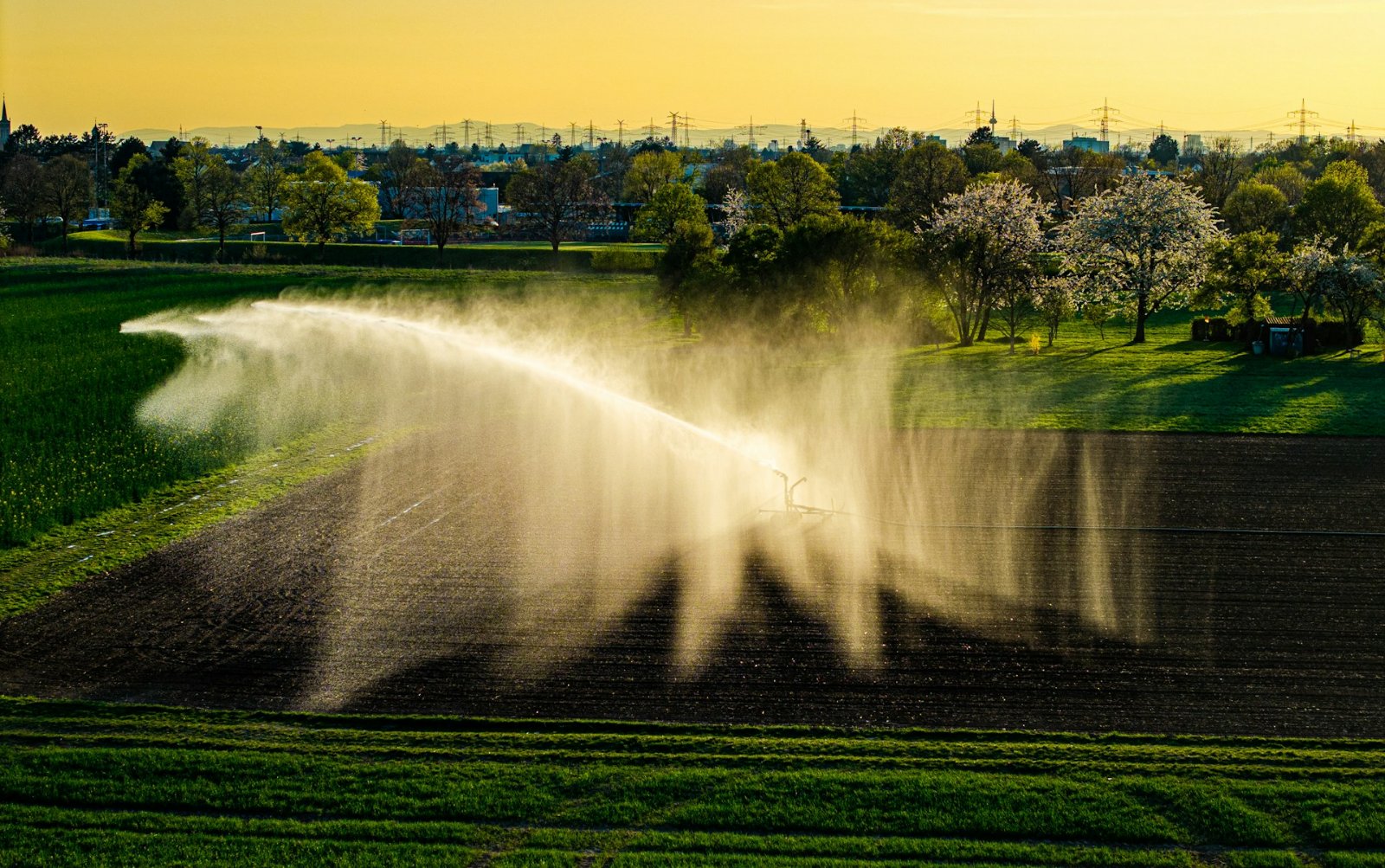
Illustrative irrigation scene in Heddesheim, Germany. Photo by Bernd Dittrich on Unsplash, used under the Unsplash License. This photograph does not show an Aurai installation.