Practical growing and systems guide · Sources checked 10 October 2026
An irrigation valve can open on schedule while the crop receives too little water. It can also keep running after the root zone has enough. For a vineyard manager, the useful question is whether the right amount reached the right place, at the right stage of growth.
Connected sensors and automatic controls can help answer that question. Their value depends on the growing target, the quality of the measurements and what happens when equipment fails. Adding artificial intelligence does not remove those requirements.
This article combines published agricultural guidance with a proposed AIoT irrigation architecture. AIoT means artificial intelligence combined with connected sensing and equipment. The architecture is educational; it is not a description of a verified Aurai installation or a promise of water savings or higher yield.
Start with the block’s growing conditions
There is no single temperature, humidity or soil-moisture setting that defines ideal vineyard conditions around Sydney. Wine Australia’s regional descriptions illustrate the spread: the Hunter Valley has warm, humid conditions, while the Southern Highlands is cooler, with vineyards reaching substantial elevations. Those are regional descriptions, not operating setpoints for individual vines. Wine Australia: Hunter Valley; Southern Highlands.
Start a block record with variety, rootstock, vine age, crop purpose, soil profile, drainage, effective rooting depth and irrigation layout. Add the current growth stage and the quality outcome the crop must meet. Include canopy exposure, airflow, water quality and nutrition in the assessment. A soil that stores substantial water needs a different schedule from a shallow, freely draining profile.
The practical target is a suitable range for that block and stage, agreed with the grower or viticulturist. It should include when to irrigate, how much can safely be applied, and what evidence would trigger a review. Maximum vegetative growth is not automatically the commercial objective.
Where salinity is a concern, test irrigation water and the root zone. Tolerance varies with rootstock, and electrical-conductivity results from different test methods are not interchangeable. Wine Australia and SARDI: vineyard salinity management.
Wine grapes and table grapes need different decisions
NSW vineyard guidance identifies flowering and fruit set as sensitive to water shortage. Later water management depends on the intended fruit outcome. Healthy, functioning leaves remain important through ripening, and suitable postharvest water status helps vines rebuild reserves. Variety and rootstock also affect water requirements. NSW DPI: monitoring vine water status.
For some wine-grape blocks, a carefully managed deficit may be part of the quality strategy. That requires a stage-specific plan and observation of vine response. AWRI cautions that rainfall and high water storage can make regulated deficit irrigation difficult to control. Restrictive soil layers can also complicate water movement. AWRI: limitations of regulated deficit irrigation.
Do not transfer that strategy automatically to table grapes. Agriculture Victoria describes table grapes as sensitive to water stress through most growth stages. Marketable berry size and condition need to be part of their irrigation decisions. Agriculture Victoria: using soil-tension measurements.
The same discipline applies across horticulture: an orchard or vegetable crop needs its own root-zone assessment and crop-specific limits. A vineyard schedule is not a ready-made prescription for the next paddock.
Measure the soil, weather and delivery system
A useful monitoring plan connects several observations.
- Root-zone moisture: Place sensors in representative soil and irrigation zones, at depths that reflect active roots and help reveal water moving beneath them. Check installation and soil contact, calibrate or ground-truth readings as the instrument requires, and establish local refill and upper limits. A percentage reading is not a universal measure of plant-available water. Agriculture Victoria: soil-moisture monitoring guidance.
- Local weather: Temperature, relative humidity, rainfall, wind and solar radiation help explain water demand. Keep records of siting, shielding, maintenance and data freshness. Forecast rainfall is useful context; verify whether rain actually reached the block.
- Flow and pressure: Measure delivered volume and check pressure at appropriate points. Together, departures from the expected operating pattern can flag a problem worth inspecting, including a leak, blockage, pump fault or valve problem. They do not identify every fault on their own.
- The vine itself: Include field inspections and, where suitable, plant-water-status measurements interpreted by someone familiar with the crop. A healthy-looking dashboard cannot establish that every vine is receiving adequate water.
Under drip irrigation, sensor position relative to emitters matters. A probe in the wettest spot may miss a dry part of the root zone; one outside the wetted zone can tell a very different story. Inspect the soil profile and wetting pattern before relying on either reading.
Use a water balance to look ahead
Evapotranspiration combines water lost from the soil and through the plant. Reference evapotranspiration, usually written ETo, describes atmospheric demand for a reference surface. Multiplying it by an appropriate crop coefficient, Kc, estimates crop evapotranspiration, ETc, under standard, non-stressed conditions. FAO: crop evapotranspiration.
Keep a root-zone water account: start with estimated stored water, add effective rainfall and irrigation entering the root zone, then subtract crop use and losses such as deep drainage. Runoff and application losses mean neither all rainfall nor all metered irrigation necessarily becomes usable storage. FAO: root-zone water balance.
Canopy development, growth stage and local conditions affect the estimate. Check the model against soil and vine observations rather than letting small errors accumulate.
For scale, 1 mm over one hectare is 10,000 litres. That unit conversion helps connect an estimated depth with pump capacity and watering time. In a drip system, define whether a depth refers to the full block or wetted area before converting it to volume. Use measured delivery and a consistent area basis.
Close the loop locally
A closed loop measures conditions, makes a bounded decision, applies water and measures the result. Here is a proposed sequence for one irrigation zone.
- Validate the inputs. Check timestamps, plausible values, battery state and agreement between relevant observations. Missing data must not silently become a “dry soil” signal.
- Decide within approved limits. Use the block’s refill point, water balance, growth stage and forecast. Separate start and stop thresholds, called hysteresis, help prevent repeated switching around one noisy reading.
- Apply a bounded amount. The local controller opens the assigned valve under a maximum volume and maximum runtime. It records the command and acknowledgement, then checks that flow and pressure are plausible.
- Verify the response. Confirm water delivery during the run. After allowing for infiltration and sensor response, check whether the root zone changed as expected. An unexpected result should trigger investigation. Do not extend the run beyond its approved limits.
- Record and review. Save the reason for the run, volume, duration, warnings, soil response and any operator override.
The stop decision should not depend only on an immediate moisture increase: water may take time to reach a sensor. Volume and runtime limits still apply while the system waits.
Machine learning could help estimate demand or detect unusual patterns once representative data exists. Compare it with a simple rule-based or water-balance baseline first. Any model recommendation should remain inside limits set by the operator and enforced independently of the model.
Plan for faults before handing over a valve
The controller that enforces shutdown limits should operate locally and independently of the AI service. For a routine irrigation zone, a verified fail-closed arrangement or independent isolation valve may be appropriate. Choose and test the safe state for the actual pump, valves and hydraulic system; a valve is not necessarily closed just because power disappeared.
A suspected leak, abnormal pressure, stuck valve or unreliable sensor should invoke a predefined response and alert the responsible person. Include a physical manual override, an accessible isolation method and a clear recovery procedure. Test loss of power, stale readings and interrupted communications before unattended operation.
A cloud connection can support reports, remote oversight and model updates. It need not sit in the time-critical control loop. During an outage, the local controller should retain approved limits and follow an explicitly configured, tested offline policy. Store records for later synchronisation, and reject expired or duplicate commands when connectivity returns.
Irrigation has limits
Adequate water can support vines through heat, but routine irrigation cannot hold open-air temperature or humidity at a chosen value. Canopy management, exposure, drainage and disease management still matter. Wine Australia: managing vines through heatwaves.
Frost protection is a separate design problem. Ordinary drip irrigation should not be presented as a frost-protection system. Where purpose-designed sprinklers are used, water supply, application rate, timing and uninterrupted operation are critical. Once started during a frost event, they must keep operating until conditions allow a safe stop. Keep their safety logic separate from routine moisture control. Wine Australia: frost management.
Five checks before a pilot
- Define one block’s crop objective, growth stage and irrigation limits with the responsible grower or adviser.
- Inspect the roots, soil profile, wetting pattern and delivery uniformity; verify the sensors.
- Run in advisory mode first and compare recommendations with observations and existing practice.
- Test the volume cap, runtime cap, isolation, manual override and offline behaviour.
- Track applied water, marketable yield and quality, labour, energy, faults and missing data against a documented baseline.
Record weather and other management changes alongside the results. A successful command proves that a valve responded. A useful irrigation system must also show what happened to the water, the root zone and the crop.
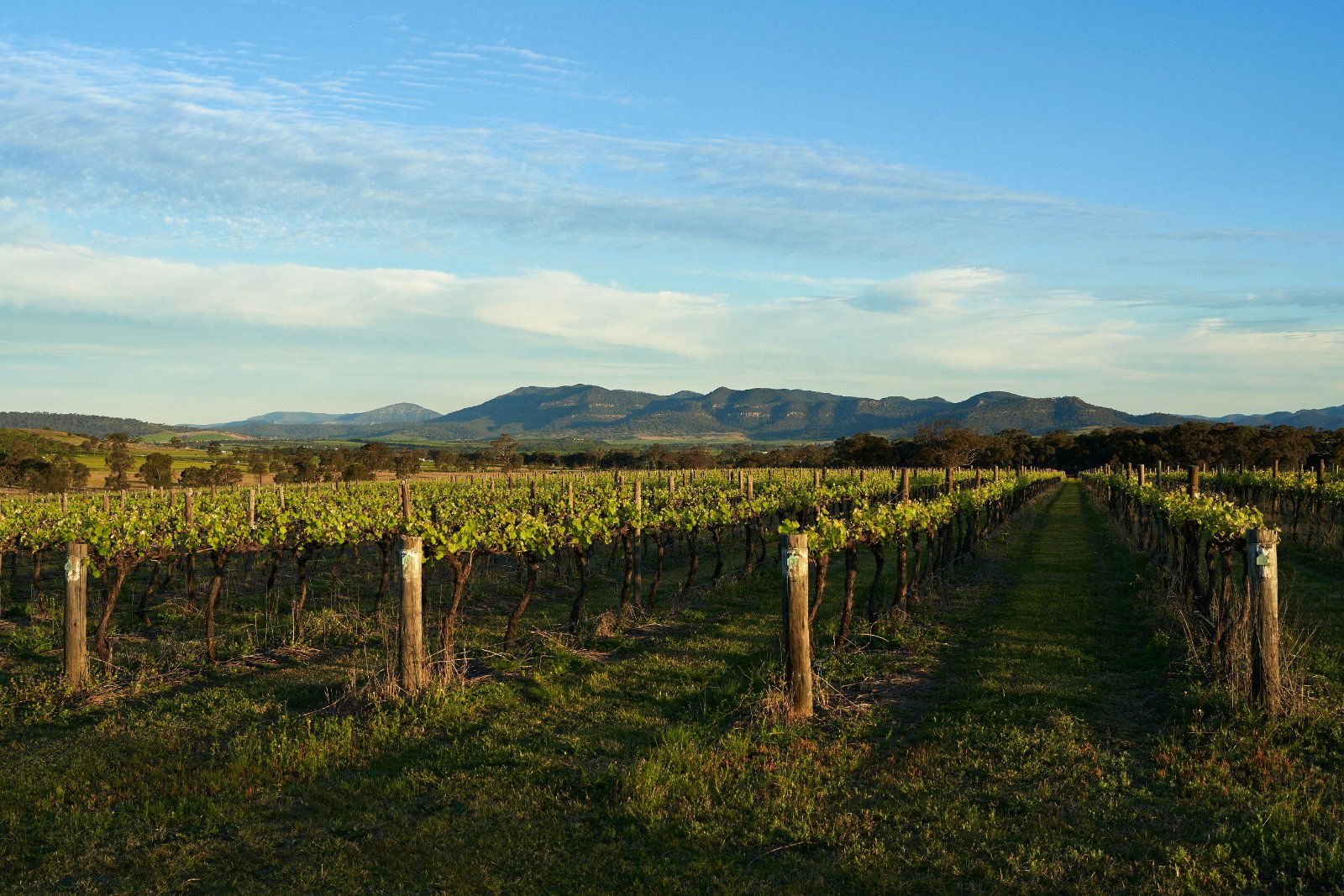
Cover: Vineyard in Denman, NSW. Photo by Arie Oldman on Unsplash. Illustrative regional photograph.