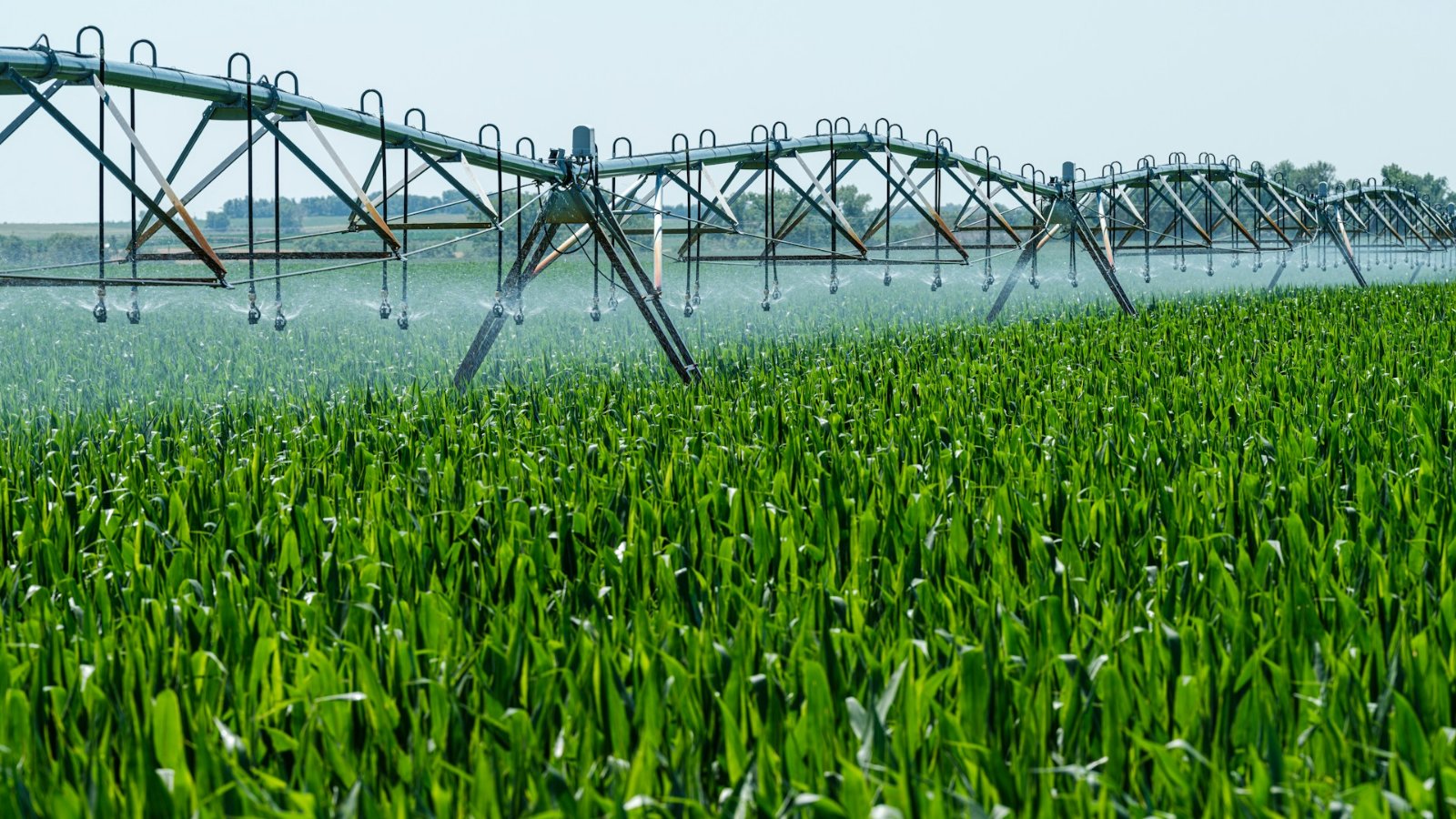
Illustrative cover: a corn crop under irrigation in Nebraska, USA. Photo by Lumin Osity on Unsplash, used under the Unsplash License.
Seasonal planning note · Sources checked 8 October 2026
A crop can still be standing when its value starts to fall. Smaller fruit, damaged skins or lettuce that misses the buyer's specification can matter well before a field looks lost.
For growers around Hawkesbury and Bilpin, that makes the practical question fairly specific: can the crop get the water it needs through the next hot spell, and how will we know?
This is a review of published agricultural guidance and seasonal outlooks. It contains no Aurai trial results, measured water savings or forecast of losses on individual farms.
What the seasonal signal tells us
The Bureau of Meteorology's overview issued on 29 September 2026 described a strong El Niño. It also cautioned that a strong Pacific signal does not necessarily produce equally strong Australian rainfall or temperature impacts. Other climate influences matter. BoM Southern Hemisphere monitoring.
The outlook issued on 1 October pointed towards above-average temperatures across most of Australia for October to December. Rainfall was less straightforward: much of eastern Australia had roughly equal chances of above- or below-average rainfall. That is a dated regional outlook, with uncertainty, rather than a prediction for a particular paddock. BoM outlook issued 1 October 2026.
We would use that information to prepare for heat, then keep checking local forecasts, the crop and the water supply. There is no sound basis here for putting a single percentage on the losses Sydney's growers will face.
Quality belongs in the water conversation
NSW's orchard guidance links water stress with smaller fruit, quality problems and poorer tree health. It also warns that excess irrigation can damage roots and fruit quality. Simply increasing every irrigation run is a poor substitute for understanding the block. NSW DPIRD orchard irrigation guidance.
Lettuce offers another example. Queensland's growing guidance explains that varieties perform within particular temperature ranges: warmer conditions can trigger bolting in cool-weather varieties, while excessive heat compromises head quality in warm-weather varieties. Lettuce is also sensitive to water stress. These are useful crop principles; the page's Queensland irrigation schedules should not be copied straight onto a Hawkesbury farm. Business Queensland lettuce guidance.
The commercial implication is worth keeping in view. Harvest weight alone can miss a problem. Record how much meets the intended grade, how much is downgraded and what each grade actually returns.
A small depth of water becomes a large volume
An extra 2 mm across one hectare is 20 cubic metres, or 20,000 litres. Across five hectares it is 100,000 litres.
That is a unit conversion, not a prediction of this season's extra water demand. It excludes application and conveyance losses. Its purpose is to make a capacity question tangible: if demand rises, can the system deliver the required volume within the available watering window?
NSW water guidance notes that vegetable crops commonly have shallow roots and limited soil-water storage, with requirements changing through crop development and weather. It recommends matching applications to the site and local conditions, and maintaining irrigation performance. NSW horticulture water guidance.
A useful pre-heat check therefore includes available storage, dependable replenishment, measured delivery rate and the time needed to serve each block. Test those assumptions against the actual system. A pump's nominal specification alone will leave important questions unanswered.
Four questions worth connecting to data
Is the root zone running short?
Soil-moisture readings at appropriate depths can show stored water and how irrigation moves through the profile. Their interpretation depends on soil, crop and location. NSW DPIRD discusses these differences alongside the use of moisture and flow sensors in orchards. NSW DPIRD orchard irrigation guidance.
Our suggested starting point is to choose representative locations with the grower or agronomist, record the installation details, and check readings against conditions in the soil. A universal alert threshold would skip that work.
What is happening in this block?
Temperature, humidity, wind, rainfall and solar radiation help explain changing crop-water demand. NSW's on-farm weather-station work includes Bilpin and describes differences between orchard conditions and readings from stations kilometres away. NSW DPIRD orchard weather-station case study.
Local observations add context to forecasts. Keep the sensor's position and exposure in the record so an unusual reading can be investigated.
Did the irrigation run deliver water?
A flow meter measures actual delivery through the monitored line. Pair that record with the moisture response after irrigation. If the expected response is missing, investigate the equipment, distribution, sensor and soil before deciding which explanation is right.
Can someone act on an alert?
Before relying on remote monitoring, run a practical test: can the person responsible receive the message, identify the block and check the problem? Decide what happens when power, communications or the sensor fails. These are proposed operating checks, not claims about an Aurai installation.
Some risks need a different kind of evidence
For Hunter Valley vineyards, smoke exposure deserves separate attention. AWRI identifies growth stage, variety, smoke composition and exposure duration as factors in smoke-taint risk, and recommends appropriate grape testing to support decisions. An ordinary particulate reading should not be treated as a diagnosis of fruit quality. AWRI smoke-taint guidance.
The same discipline applies to irrigation monitoring: be clear about what a measurement represents and where its interpretation stops.
What we would count as useful evidence
For a monitoring trial, we would want a record of the starting conditions, readings, management decisions and resulting crop performance. Useful measures include:
- Water applied per kilogram of marketable produce
- Marketable yield and grade distribution
- Pumping, labour and maintenance costs
- Data gaps, missed alerts and time taken to investigate problems
Weather, variety, soil and other management changes belong beside those numbers. Otherwise, a favourable season can be mistaken for a technology result.
Growers looking for practical local support can also check LLS's Waterwise for the Future programme. It covers Greater Sydney and the North Coast, with irrigation assessments, demonstrations and training. Its June 2026 update describes a vegetable-grower workshop on cabbage irrigation, soil health and moisture probes. LLS Waterwise for the Future.
The immediate job is manageable: check one block, verify one irrigation run and make sure somebody can act when the evidence says something is wrong. Any claim about what the technology saved should come after the measurements.