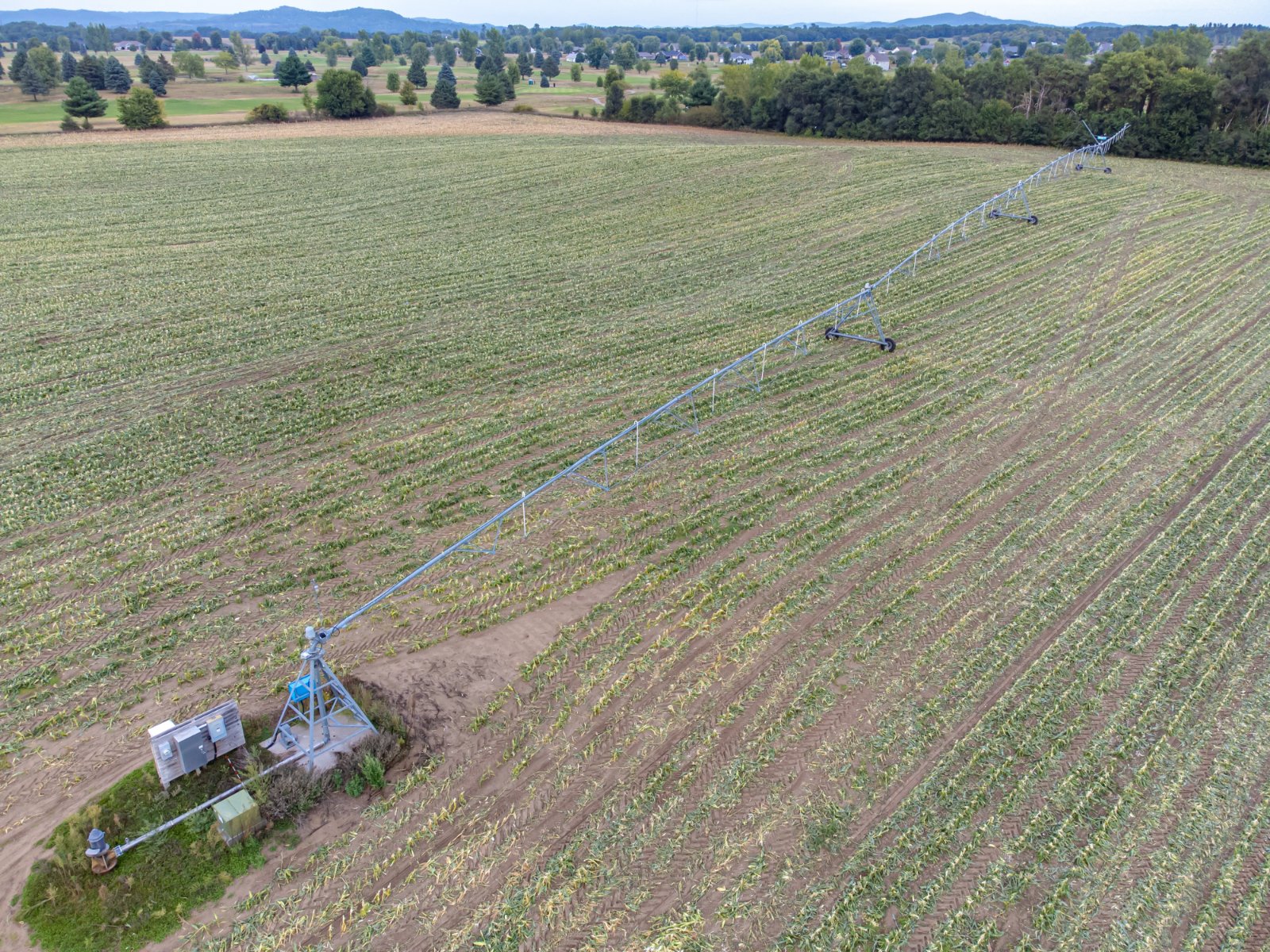
Illustrative cover: an irrigation system extending across a cultivated field. Photo by Wikideas1, via Wikimedia Commons, dedicated to the public domain under CC0 1.0.
Practical irrigation note · 19 October 2026 · Sources checked 19 October 2026 (Sydney)
A full dam answers one question: how much water is available? Before that water reaches a crop, growers need a second answer: is its quality suitable for this block?
The distinction matters when planning irrigation around changing supplies. In its 15 October update, ABARES reported Murray–Darling Basin storages at 15,028 GL, or 68% of capacity. It also forecast rain across much of eastern Australia for 15–22 October. Those are basin-scale storage observations and a dated rainfall forecast. Neither measures the salt concentration in an individual farm's dam, bore or irrigation line. ABARES update, 15 October 2026.
Our practical response is to put water-quality checks alongside the water budget. This article draws on government guidance; it reports no Aurai trial results or farm-specific diagnosis.
Why salt can matter before the crop looks stressed
Dissolved salts can make it harder for roots to take up water. A wet root zone can therefore still present a water-uptake problem. NSW DPI's November 2011 irrigation-water guidance also identifies sodium, chloride and boron as potential toxicity concerns. Susceptibility varies between crops and growth stages, with germination and seedlings particularly vulnerable. NSW DPI, Irrigation water quality.
For the business, the question is whether a change in supply could compromise establishment, marketable yield or future use of a block. Waiting for visible damage makes that decision harder. Include testing costs and any alternative supply in the irrigation plan before the crop depends on them.
Start with EC, then ask what it leaves out
Electrical conductivity, or EC, provides an indication of dissolved salt concentration. It does not identify which salts are present. Agriculture Victoria explains that irrigation suitability also depends on the crop, variety, growth stage and soil drainage. A number taken from a general table cannot settle all of those questions. Agriculture Victoria, Water quality for farm water supplies.
Keep units beside every reading. For conductivity, 1 dS/m equals 1,000 µS/cm. A reading of “800” without its unit is an invitation to error. Record whether a sample came from the source or from water after fertiliser was added, so unlike measurements are not compared as though they were equivalent.
A useful record includes the date, source, sampling point, instrument, calibration check and recent changes in operation. If a reading suddenly shifts, confirm it before building a management decision around it.
Check the sodium risk as well
Salinity and sodicity describe different problems. Salinity concerns total dissolved salts. Sodicity concerns the proportion of sodium and its effects on soil structure. In water, SAR compares sodium with calcium and magnesium.
Agriculture Victoria's guidance for the Shepparton irrigation region describes a complication: saline water can temporarily help stabilise clay even while sodium accumulates. When fresher water follows, susceptible soil can disperse, reducing infiltration. The region's numerical examples should not be transferred to a NSW orchard or vegetable block. The wider lesson is to interpret water chemistry and soil condition together. Agriculture Victoria, Effects of irrigating with saline water on soil structure.
Before switching supplies or planning a corrective treatment, ask an adviser to review sodium adsorption ratio (SAR), EC and relevant soil tests. Avoid choosing a gypsum rate or a leaching programme from the EC reading alone.
Make the sample useful to the person interpreting it
NSW Government guidance recommends an accredited laboratory, representative sampling and tests matched to the intended use. Water quality can change with rainfall, runoff, evaporation and contamination. Unexpected or borderline results warrant checking again. NSW Government, Water quality testing and sampling in agriculture.
Tell the laboratory and adviser which crop and growth stage are involved, how water is applied, and whether supplies are blended. Ask which analyses are needed: EC and pH may be a starting point, with SAR, chloride, alkalinity, hardness or other constituents relevant to the situation. Follow the laboratory's container, handling and delivery instructions.
Keep separate records for each source. One acceptable dam sample does not establish that a bore, a blend or next month's supply will behave the same way.
Respond to the cause before adding more water
Leaching can move salts below the root zone, but drainage and the destination of that water matter. Agriculture Victoria warns that restricted drainage limits the use of saline irrigation water. Adding water without understanding the profile can leave the underlying problem unresolved. Agriculture Victoria water-quality guidance.
Equipment deserves attention too. NSW DPI describes iron-related blockages and calcium deposits that can obstruct irrigation equipment. A water-quality investigation may therefore need a delivery-system check as well as a crop assessment. NSW DPI irrigation-water guidance.
For a problem block, bring together the water test, soil results, applied volumes and observations of infiltration. Agree on the response with the adviser, then record what changed and whether the expected improvement occurred.
A practical checklist for this week
- Map the supply: list the source or blend feeding each block and locate the latest laboratory result.
- Verify a baseline: check the EC meter and log a representative reading with units and sampling details.
- Identify vulnerable decisions: flag new plantings, sensitive crops and blocks about to change water source.
- Book the right tests: give the laboratory and adviser the crop, soil and irrigation context.
- Set an action: decide who investigates a changed reading and which supply options are available while it is assessed.
- Review the outcome: retain readings, decisions, crop observations and costs in the same block record.
For monitoring, the useful outcome is a defensible decision: this water, for this crop, on this soil, under these conditions. A sensor trend can prompt the investigation; laboratory evidence and local agronomic judgement make the response specific.
For the wider delivery and soil-moisture checks, see our vineyard irrigation field note.