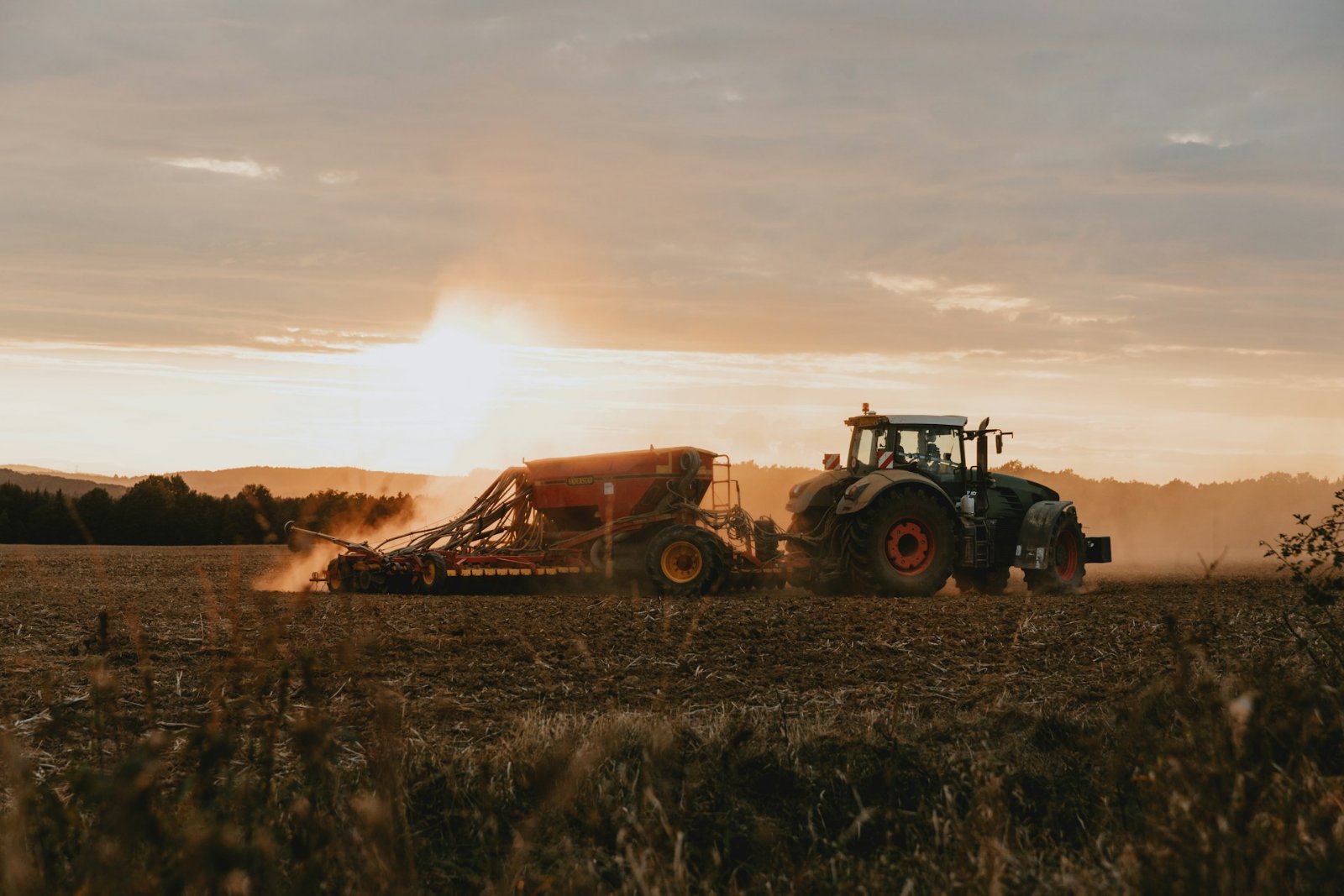
Illustrative cover: a tractor and seed drill in a field at sunset in the Czech Republic. Photo by Tomas Hudolin on Unsplash, used under the Unsplash License. This is not an Aurai field trial or evidence of soil damage at the photographed site.
Farm management note · Sources checked 2 November 2026
A busy harvest window can make a damp paddock look like a scheduling problem. The cost may extend beyond today's job: wheel traffic can leave a soil problem that the next crop has to live with.
A fresh Iowa State University Extension advisory, published 23 October 2026, highlights that tension during a wet US harvest. It warns that modest surface rutting can conceal deeper damage, and that a first machinery pass can already cause substantial compaction.
This note translates that management question for Australian growers planning machinery work after rain or irrigation. It is not an Australian rainfall forecast, and US yield-loss figures are not predictions for your farm. The checklist below is our suggested workflow, informed by published guidance, not an Aurai trial or a guarantee of savings.
Start with the decision, not the machine
Write down what needs to happen today and what can move. Is crop quality deteriorating? Is a contractor available only briefly? Could another block be worked first? Put the immediate cost of delay beside the possible cost of damaged access, additional passes and later investigation.
Assign one person to make the go, wait or change-route decision. Operators need a clear way to stop and ask for a reassessment. A plan that only exists in the manager's head is difficult to follow when trucks arrive and priorities change.
Check below the dry-looking surface
Queensland Government guidance explains how compression disrupts the spaces used by roots, water and air. Warning signs include ponding in tracks, smeared wheel marks and distorted roots. Those observations justify closer inspection; they do not, on their own, identify the depth or cause of every problem.
Our practical starting point is a short walk through representative soil zones, wet hollows, headlands and the proposed haul route. Record where you inspected, recent rainfall or irrigation, and conditions below the surface. Compare a traffic area with a nearby crop area rather than assuming one convenient sample describes the paddock.
Queensland's clay-soil rolling test is a cultivation warning, not a universal clearance test for every soil and loaded machine. There is no single moisture percentage or fixed number of hours after rain that we can responsibly prescribe here. Agree a site-specific assessment with a qualified local adviser.
Plan where the weight goes
The Iowa advisory recommends concentrating traffic, avoiding full loads through the wettest areas where practical, and keeping heavy grain-handling activity near the field exit. Tyre inflation must remain within the manufacturer's recommendations for the actual load and operating speed. These principles are more useful than copying a US machine's axle-load example.
For today's operation, mark the intended entry, exit, turning points and transfer area on a simple map. Give contractors the same version. Check that the route is physically safe and suitable before directing traffic onto it; protecting soil does not justify an unsafe unloading location or overloaded vehicle.
NRE Tasmania's guidance distinguishes surface contact pressure from the effect of axle load deeper in the soil. It also cautions that pressure is not uniform along a track system. Tracks or wider tyres should not be treated as permission to ignore soil condition. Controlled traffic separates machinery lanes from the crop-growing area.
Keep a note of deviations from the plan. If an operator has to cross a wet patch, knowing exactly where is more useful for follow-up than a general comment that the field was difficult.
Use sensors to support an inspection
For farms already collecting soil-moisture data, we suggest adding the machinery decision to the same record: block, sensor location and depth, observation time, field inspection and the action taken. This can help a manager review why a job proceeded or was delayed.
A moisture trace is not a direct measurement of load-bearing capacity. Treat an uncalibrated traffic-light alert as a prompt to inspect, not an automatic instruction to enter. Check that the reading is recent and representative; a failed sensor or a probe in a different soil zone should not silently decide a machinery movement.
If testing an automated advisory system, keep the operator responsible for the decision. Record disagreements between the recommendation and the field assessment. These are proposed evaluation practices, not capabilities or performance results claimed for an Aurai product.
Diagnose before booking remedial tillage
University of Wisconsin Extension cautions that ruts do not necessarily mean deep tillage is needed. Soil pits, probes and penetrometers can help investigate whether a restrictive layer exists. Queensland also warns that ripping wet soil can cause further smearing and compaction.
Mark suspect areas after the operation and ask what evidence would justify treatment: location, depth, soil type and the condition needed for an implement to work effectively. Seek local advice before choosing a treatment. A recommendation for one soil or climate is not a prescription for every Australian paddock.
Before spending money, agree how the result will be checked. Keep treatment and untreated observations separate where practical, and record later weather and crop management. A better-looking crop alone does not establish that a particular intervention paid for itself.
A six-point pre-start checklist
- Priority: identify the essential job and the cost of waiting.
- Ground check: inspect representative areas and the planned route.
- Equipment: confirm load, tyre settings and operating limits.
- Traffic: share entry, exit and transfer locations with the team.
- Authority: name the person who can stop or change the operation.
- Follow-up: record suspect areas and investigate before treatment.
The useful outcome is a documented decision suited to the field that day. Better records make the next decision easier to defend, whether the right choice is to proceed, change the route or wait.
Sources and scope
Iowa State's advisory was published 23 October 2026. Queensland's page was last updated 18 December 2013 and reviewed 25 May 2026; it is background guidance, not a new trial. NRE Tasmania lists a last-published date of 17 September 2026. Wisconsin's page does not display a publication date. Links above lead to the original sources. No farm-specific yield, cost or return estimate is made.